
When does Wikipedia say "murder"?
It's not as complicated or political as people like to claim.

This is how things unfold now. First, there is another high-profile killing of a person. This means there is a new Wikipedia article about said killing. Which means there are people arguing on social media and in the Talk page for the Wikipedia article about why said article should say “murder” instead of “killing” or “shooting.”
This is a regularly recurring argument that we cycle through every time someone is killed in a high-profile way, i.e. the kinds of killings that dominate the 24-hour news cycle. Examples from recent history include Charlie Kirk, Iryna Zarutska, Brian Thompson. I’m sure you could tell me others I’m forgetting.
Here is a pastiche of screenshots that was going around conservative corners of the internet after the death of Charlie Kirk. The purpose of this was to “prove” the liberal bias of Wikipedia:
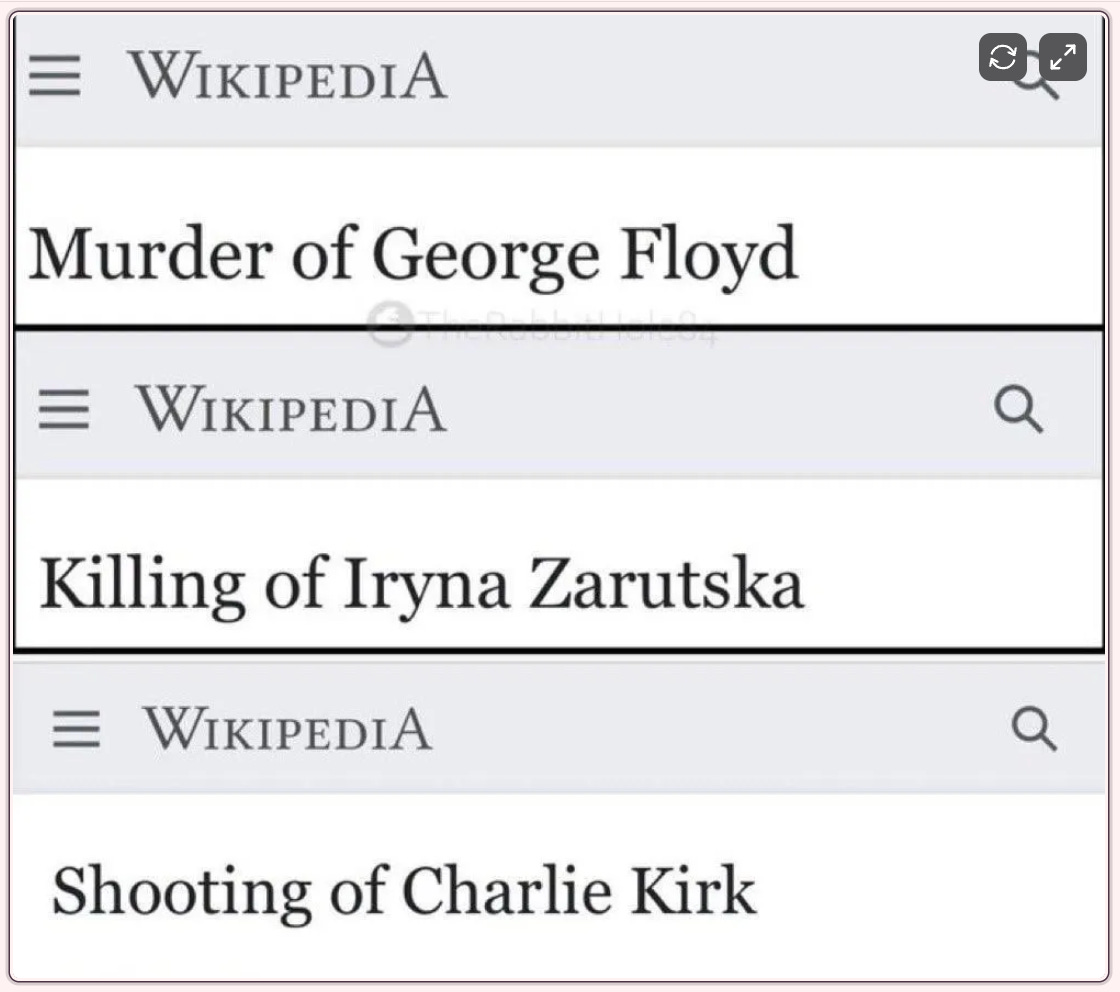
In the aftermath of Charlie Kirk’s death, Wikipedia became even more of a target for rightwing media personalities. The above meme (if that’s the right name for it) circulated while people argued that Wikipedia was failing to properly eulogize Kirk.
But that’s not what I’m here to write about. Stephen Harrison already did a good job writing about that particular story in Slate.
I want to take look at something very specific. The question I ask in the headline. When does Wikipedia say “murder” and what systems has Wikipedia put in place to prevent the word “murder” from being preemptively used?
It’s not a murder until there’s a conviction.
The answer for when Wikipedia calls someone a murderer and a killing a murder is very simple: when there is a conviction.
In the screenshot above (Murder of; Killing of; Shooting of), there are simple explanations:
Derek Chauvin was convicted of the murder of George Floyd. Before the conviction, it said “Killing of George Floyd.”
Iryna Zarutska’s killer had not been convicted of her murder. (It remains “Killing of” because there has not been a conviction yet.)
Charlie Kirk had been shot but hadn’t died yet. (The Wikipedia article was created moments after he was shot; he wasn’t declared dead until later that day. It went from “Shooting of” to “Killing of” to “Assassination of,” which I’ll discuss more below.)
This “call it a murder” argument is currently unfolding around the killing of Renée Good. You can look into this on social media (if you so choose; I wouldn’t recommend it), but here’s a screenshot of the Talk page of the Wikipedia article:
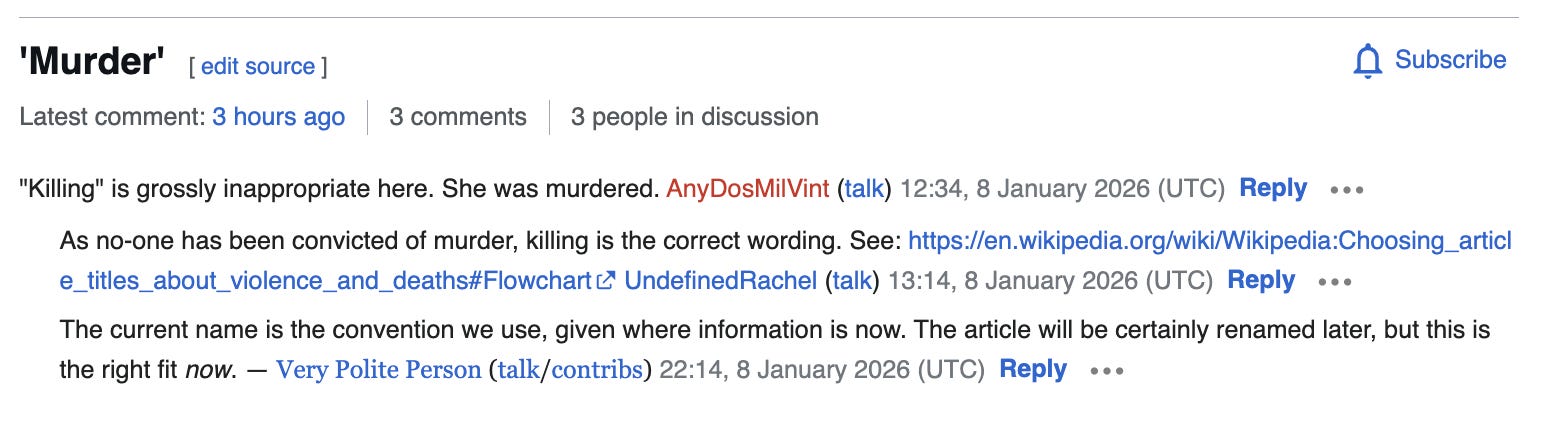
Like I said above, the answer to this is simple: the killing of Renée Good has not resulted in a criminal conviction. It may never, in which case the page will continue to say “Killing of Renée Good.”
Let’s look at how Wikipedia enforces this practice.
There are a few ways that Wikipedia prevents people from calling something a murder before it can or should be called a murder.
The first is known by the shorthand BLPCRIME, i.e. the content policy for “People accused of crime” under the overall “Biographies of living persons” content policy.
You may have heard of this one before. BLP first became a content policy in the aftermath of a random guy being accused of JFK’s assassination. The random guy in question was journalist John Seigenthaler, who had nothing to do with JFK’s death, whose Wikipedia article once said:
John Seigenthaler was the assistant to Attorney General Robert Kennedy in the ealry [sic] 1960’s. [sic] For a brief time, he was thought to have been directly involved in the Kennedy assasinations [sic] of both John, and his brother, Bobby. Nothing was ever proven.
If you think that’s bizarre, there is now an article called Wikipedia Seigenthaler biography incident, specifically about this edit and its aftermath.
For his part, Seigenthaler resisted suing anyone (even after he found the guy who made the edit) and even worried about the fallout, saying: “My fear is that we're going to get government regulation of the Internet as a result.”
So that led us to the “Biographies of living persons” content policy. Now, I’ve heard it argued that biographies of living people shouldn’t be allowed on Wikipedia at all, which I think there could be an argument for. (Just like how biopics of living people are the most annoying things ever.)
But in the case of “Killing of _____” and “Murder of _____”, you might wonder: how is this even relevant? We aren’t talking about biographies of living people.
It matters because Wikipedia can’t call someone like Luigi Mangione a murderer, even if a lot of people consider him to be one. Here is the first sentence of Mangione’s Wikipedia article:
Luigi Nicholas Mangione (/ˌmændʒiˈoʊni/ ⓘ MAN-jee-OH-nee;[3][4] born May 6, 1998) is an American man accused of killing Brian Thompson, the CEO of UnitedHealthcare.
Note that the word murder or a variant of it is still used 51 times on Mangione’s article, but always in the context of “accused of” or “alleged.” And “Killing of Brian Thompson” has murder or a variant 61 times, without saying Brian Thompson was murdered. Because that’s not for Wikipedia to decide.
Believe it or not, there is a very useful flowchart on Wikipedia for knowing how to name these articles:
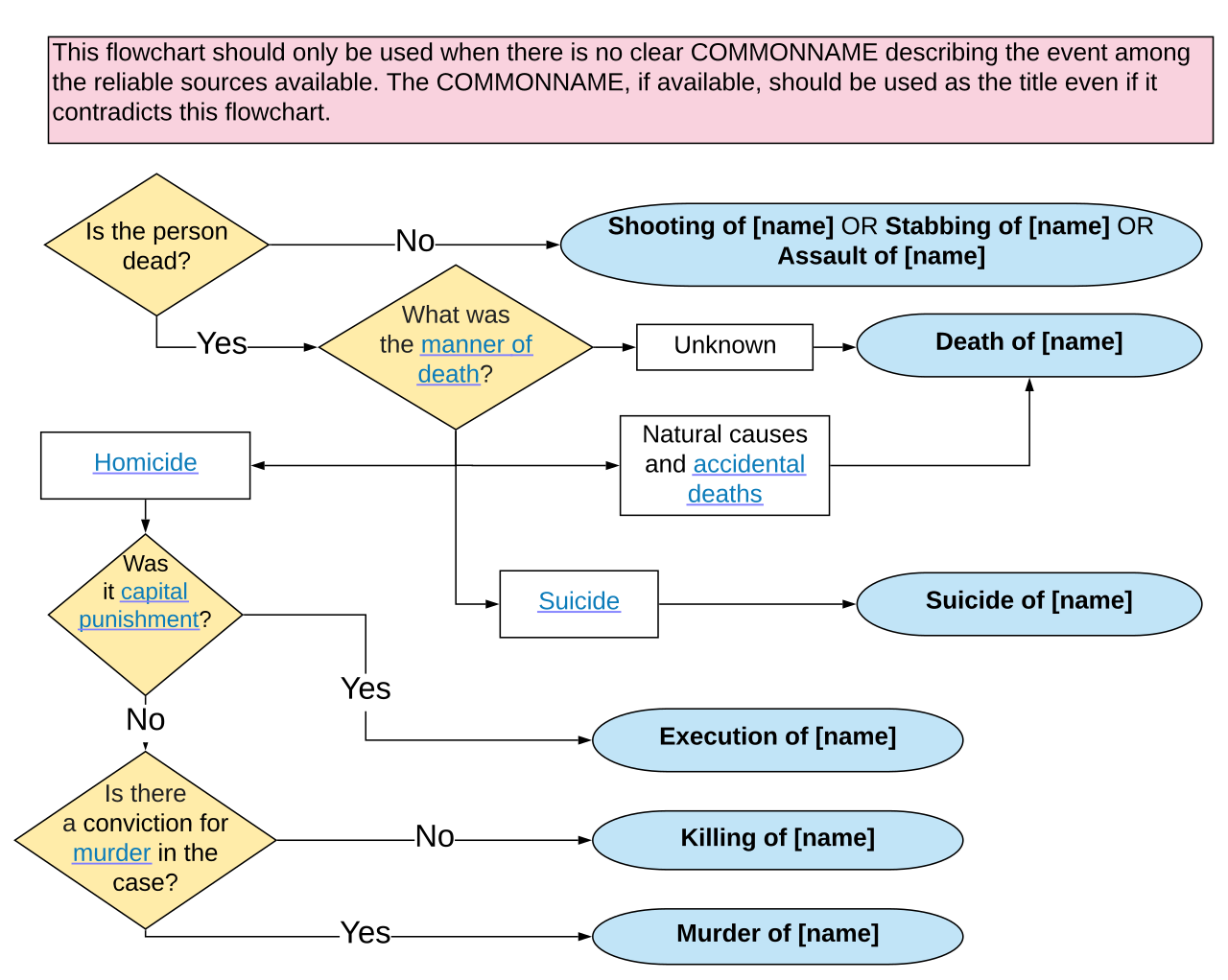
If you still have questions, read that flowchart again. Or, read the Wikipedia essay Choosing article titles about violence and deaths, from where this flowchart comes.
But we’re not done yet. Let’s say that someone reads all the above and still thinks that “Killing of Renée Good” needs to say “murder” somewhere on it. Start editing the article and you will see this message:
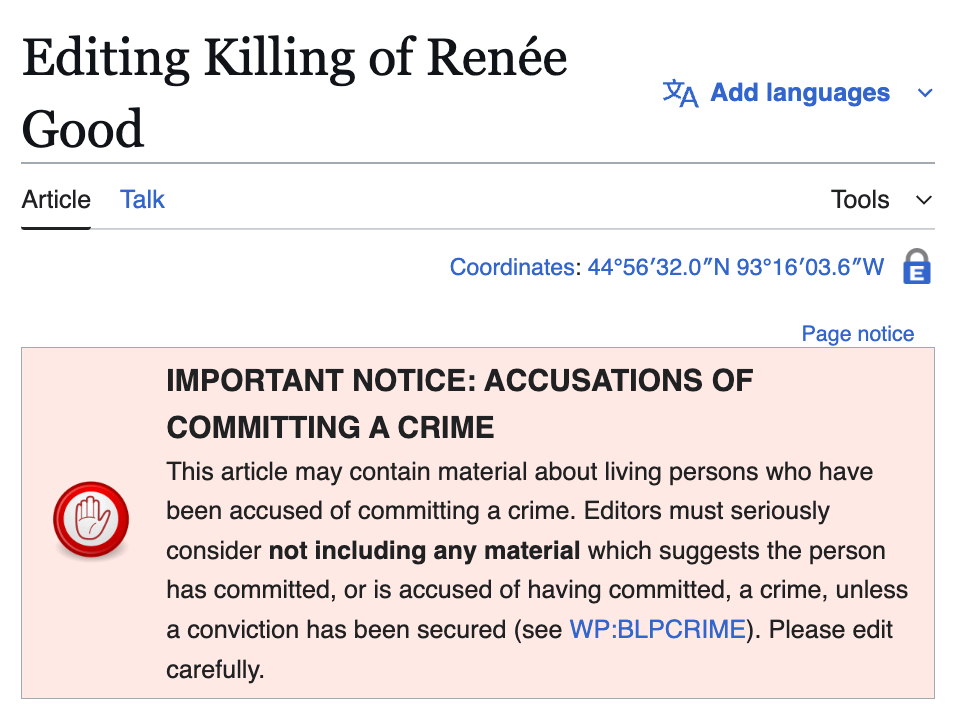
You’ll see the same message if attempting to edit “Killing of Brian Thompson.”
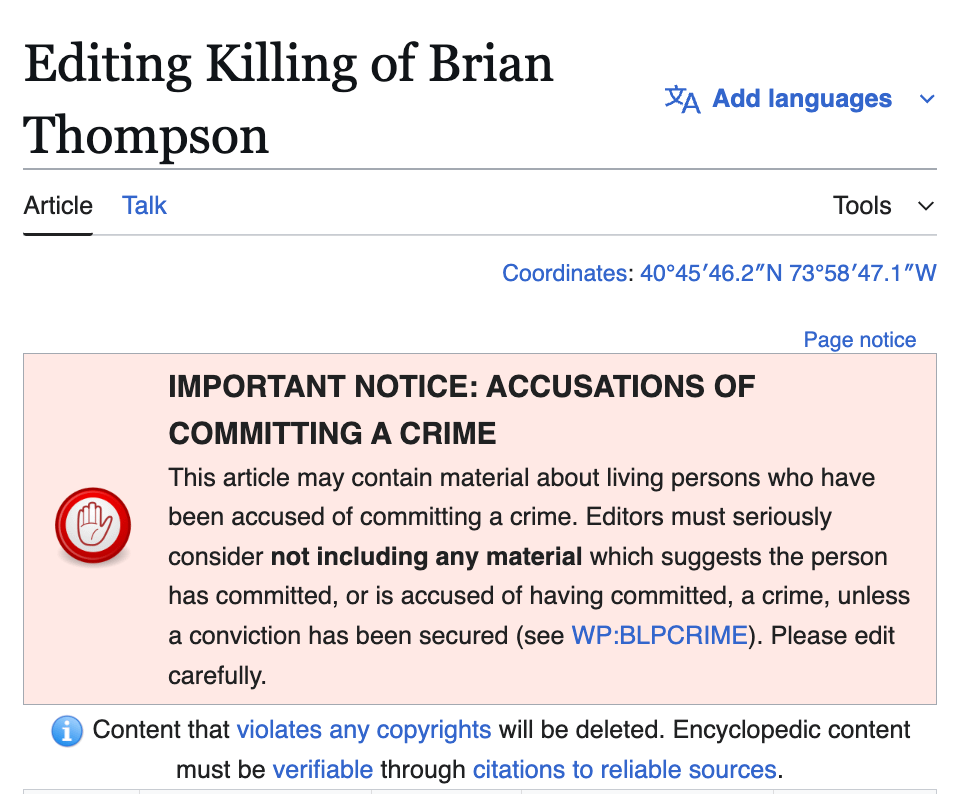
In the last 36 hours or so, the page “Killing of Renée Good” has been renamed twice, from “2026 Minneapolis ICE shooting” to “Killing of Renee Good” to its current title. It has been edited 1,020 as of this writing by 207 different accounts.
But I could see why questions might remain. Who does BLPCRIME apply to, in this context? It applies to the ICE officer who did the killing, just as it applies to Luigi Mangione on “Killing of Brian Thompson” and Decarlos Brown Jr. on “Killing of Iryna Zarutska.”
And there is still one outlying question.
When does a Wikipedia article say “assassination”?
Wikipedia currently says “Assassination of Charlie Kirk,” despite there being no criminal conviction for the person who shot Charlie Kirk. Is not assassination a weightier word than murder? Is it really easier to change a Wikipedia article’s title to “assassination” than it is “murder”?
There are 584 comments in the archived discussion for moving “Killing of Charlie Kirk” to “Assassination of Charlie Kirk,” which is where we can find our answer.
The determination was ultimately made to move it from “Killing” to “Assassination” based on the way it was being covered in the press. As summarized by the admin who. made the move:
The discussion contains substantial evidence that "assassination" is increasingly the term used by high-quality reliable sources, and that this therefore better satisfies title criteria, particularly precision and recognizability, than "Killing of"
Ultimately, what it seems to come down to is that “murder” is a legal term but “assassination” is not. Something is an assassination when society decides it was one; something is a murder when a court decided it was one. If I have somehow misunderstood this, or if the Wikipedia community has misunderstood this, please correct me.
Meanwhile, I do wonder if “Killing of Brian Thompson” should be “Assassination of Brian Thompson,” but I’ll let other people have that argument.
“Don’t criticize what you can’t understand”
I believe there are many good reasons to criticize Wikipedia and many ways that it can improve. But suggesting that Wikipedia should use the word “murder” to describe things that aren’t officially murders (yet, or maybe ever) is not one of them.
I also think there are two very different categories of Wikipedia critics: those who criticize from the inside and those who have never made an edit but think they know how it should operate. If you’re going to criticize Wikipedia, I hope you’ve tried editing it before. It’ll at least help you make better arguments.
From my long-ago newspaper days, not saying "murder" without a conviction (and similar for many other crimes) is foundationally a CYA so you don't get sued. So I have no problem seeing why Wikipedia adopted it
Brilliant post. As I read it I wondered about pre-trial publicity in the US and UK. Journalists in the US operate under far fewer restrictions than their counterparts here in the UK, and that extends to court reporting too. That must be another headache for Wikipedia.