
What should Wikipedia call something when the name is undecided?
Regarding AEO v. GEO and Juicy Lucy v. Jucy Lucy

In July of 2025, I wrote the “digital marketing industry is tearing itself apart.” I then admitted I was being dramatic, but my point stands: no one knows what to call the act of attempting to appear inside of artificial intelligence tools.
In that previous article, I asked a series of questions to a multitude of platforms. That article was called SEO v. AIO v. GEO v. AEO v. AISO v. SXO v. SEvO v. AIVO v. LLMO and ultimately it reached no conclusion because there was no conclusion to reach, other than “people sure have a lot of names for this thing.”
At the present moment, the answer is still unknown but we seem to have two chief contenders: answer engine optimization and generative engine optimization. AEO and GEO. So far, very few agencies, tools, platforms or third-party sources have taken any official stance on which of these names win.
Of what I think of as the “Big 5” tools for tracking AI visibility (Ahrefs, Peec, Profound, Scrunch and Semrush), only Profound seems to have adopted a naming convention, referring to it as AEO across their website but also calling it “AI search” in other places. Peec says “AI search” but avoids endorsing any name for the discipline. Scrunch says “AI search” and “AI visibility” across its site but doesn’t say either AEO or GEO.
And while Google and OpenAI don’t seem to have stances, Bing recently backed the GEO horse, announcing their AI Performance report in Bing Webmaster Tools, stating:
This release is an early step toward Generative Engine Optimization (GEO) tooling in Bing Webmaster Tools, helping publishers understand how their content participates in AI-driven experiences.
To make it even more complicated and annoying, both AEO and GEO have definitions entirely unrelated to answer engines or generative artificial intelligence. AEO can also stand for American Eagle Outfitters, a publicly traded company that saw its own viral news stories in 2025, while GEO is a magazine, a prefix, and a car that hasn’t been produced since 1997. (It is worth noting that the subreddit /r/aeo is dedicated to answer engine optimization while the subreddit /r/geo is dedicated to the car.)
But what I’d like to focus on is how Wikipedia is supposed to handle this situation. If society doesn’t know what something is called, should Wikipedia take a stance? How is the dark horse Grokipedia handling this? How does this relate to cheeseburgers? And also, am I right that these types of debates could be addressed by serious consideration of Larry Sanger’s second thesis or would that only make this worse?
Generative engine optimization v. answer engine optimization
As I previously wrote about in Why is ChatGPT citing deleted Wikipedia articles?, I’ve been attempting to make Wikipedia’s articles on digital marketing less bad. So far, I haven’t succeeded. One of my chief areas of focus lately has been the articles on answer engine optimization, generative engine optimization, artificial intelligence optimization and AI SEO.
Here’s the challenge I’m facing: all four of these articles might be about the exact same thing. I say “might” because I genuinely am not sure what either “artificial intelligence optimization” or “AI SEO” are supposed to be about. But I do know that “generative engine optimization” and “answer engine optimization” are both about the act of attempting to manipulate the results of an AI tool to promote a specific brand, website or service.
I know that GEO and AEO are the same thing because I’ve seen the arguments unfurl across the industry that used to be called the SEO industry and might still be called the SEO industry. Other people call it LLMO or AIVO, neither of which (as of now) have their own Wikipedia articles (although I do have a funny story to eventually tell about an AIVO evangelist’s attempt to get AIVO mentioned on Wikipedia.)
Here’s where this question gets dicey: who gets to decide if there should be a Wikipedia article on one, both, or neither of these subjects? How should it be written? When will it be decided and what decisions will factor into the decision? And how low on the priority list is this for most normal people?
Before I attempt to answer those questions, let’s consider a Minnesota burger. And then Larry Sanger.
The J(u/ui)cy Lucy, Minnesota’s favorite burger
Back in November, I exchanged a few emails with Dr. David Levinson, a professor at the University of Sydney. Levinson, if you’re not aware, is the Wikipedia editor who created the article for “Jucy Lucy” on Wikipedia in February of 2005. (David Levinson is also the name of Jeff Goldblum’s character in Independence Day, but that’s not important right now.)
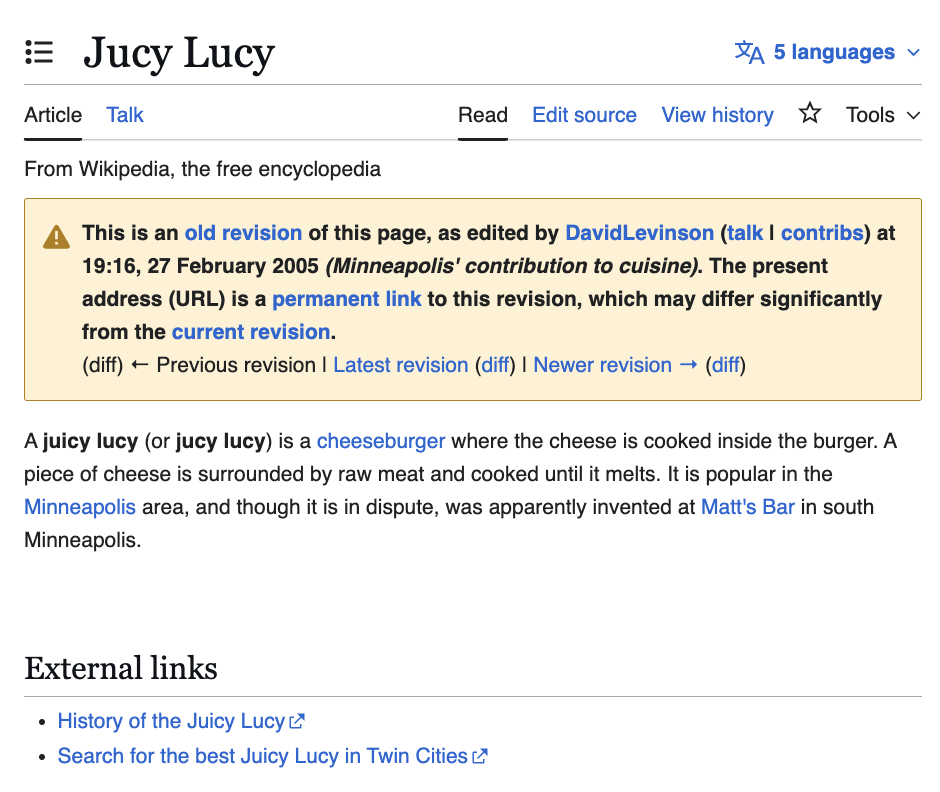
Here’s the question I asked Dr. Levinson:
When you created the page for Jucy Lucy in 2006, you named the article Jucy Lucy rather than Juicy Lucy. The original article read:
A juicy lucy (or jucy lucy) is a cheeseburger where the cheese is cooked inside the burger. A piece of cheese is surrounded by raw meat and cooked until it melts. It is popular in the Minneapolis area, and though it is in dispute, was apparently invented at Matt’s Bar in south Minneapolis.
I’m curious how you chose to name it Jucy Lucy instead of Juicy Lucy. You also mentioned Matt’s Bar but not the 5-8. Was this because of a personal preference, was it based on the references, and/or were there other factors taken into account? In the article, you said “juicy lucy (or jucy lucy)” instead of the opposite. Was this intentional?
His response:
I think for the article name it was conflict avoidance with a band.
The band he refers to is named Juicy Lucy. Their article is named “Juicy Lucy (band)” and was created in August of 2006, several months after the Jucy Lucy article.
And in response to my question about Matt’s vs. the 5-8, he added:
I believe Matt’s Bar more than the 5-8, but am not a hamburger historian.
Now, I had not considered that the article might be named “Jucy Lucy” rather than “Juicy Lucy” to avoid conflict with the band article. I assumed it to be some kind of statement about a preference for Matt’s over the 5-8. There is now a disambiguation article for “Juicy Lucy”, containing four entries: the band, the burger, and two albums.
His answer makes sense. Avoiding confusion and complication. Choose the unique spelling instead of the ambiguous one.
The challenge, as I see it, is that when an editor chooses one specific option, whether it’s choosing Jucy Lucy over Juicy Lucy or answer engine optimization over generative engine optimization, Wikipedia is taking a side in an unresolved debate and thus taking a step toward resolving that debate, whether intentional or not.
In the case of the Jucy Lucy, the consequences of this choice are low. I think it’s a quiet endorsement of Matt’s and their spelling of the burger’s name, but this edit occurred 20 years ago and both Matt’s and the 5-8 are still open, so Wikipedia’s quiet endorsement didn’t create too much unintended change.
But this is why I wonder if Larry Sanger might have a point. Should there be competing articles for these kinds of unresolved issues? And is that what’s currently happening for AEO and GEO, whether or not it’s the intention?
Larry Sanger’s second thesis
I previously referred to Sanger’s second thesis as his “third worst thesis,” saying that it sounded like a total mess. His full argument is that Wikipedia favors “the narrow perspective of the Western ruling class” and that it’s specifically “globalist, academic, secular, and progressive.” As Sanger points out, Wikipedia has itself admitted to having a systemic bias.
His solution, which I called a mess and still does sound potentially very messy to me, is that Wikipedia should “permit multiple, competing articles per topic.” He gives a specific process for how this would work, the pattern going:
New articles begin life in the Draft: namespace
Articles automatically move to the main namespace when they meet certain objective criteria.
The article creator determines who works on the article.
Competing articles about the same topic are distinguished by differing frameworks
The Arbitration Committee and other bureaucratic groups must respect the rules of each framework
A rating system, or in lieu of that, an AI system, may be used for article sorting.
Application to search results and hyperlinking.
You might guess what my greatest concern in this system is: the third part. That sounds like a good way to have gatekept universes inside Wikipedia. Part of Wikipedia’s mission (whether it’s always adhered to or not) is that anyone can edit it. This sounds like a step away from that, at least for specific articles.
Then we have the frameworks. His suggestion is that these frameworks would include, for example:
Status quo (i.e. the way Wikipedia is currently written)
Catholicism
French
Sunni
Continental philosophy
Note that these are just examples. One can imagine thousands of frameworks that might spring up.
It’s an interesting idea. And the reason I can’t get it out of my head is because it seems like it’s what’s happening right now with the “answer engine optimization” and “generative engine optimization” articles, although the frameworks that are being practiced are the topics of the articles themselves.
What I mean by this:
The generative engine optimization article was written by evangelists of the name “generative engine optimization,” while the answer engine optimization article was written by evangelists of the name “answer engine optimization.”
These articles are functionally about the same thing. This would be like if there was one article titled “Jucy Lucy (burger)” and another titled “Juicy Lucy (burger)" with the “Jucy Lucy” article insisting that Matt’s is the greatest Jucy Lucy restaurant and that Jucy Lucy is the one true spelling, while the “Juicy Lucy” article would espouse the opposite.
Let’s talk about my edits to these articles
I’ve made a variety of edits to the articles for answer engine optimization and generative engine optimization, as noted above. Part of why I feel comfortable making these edits is that I am not part of either the GEO or AEO evangelism communities. I’m not sure what the name should be. I don’t even know that it needs a fancy name.
My solution has been to add the word “arguably” throughout these articles, while attempting to increase the neutrality and flag places where citations are needed. I’ve also rewritten the first sentence of these four articles to make it clear that there is some debate and ambiguity around these disciplines, this industry, and, in particular, these naming conventions.
The first paragraph of “answer engine optimization” currently reads:
Answer engine optimization (AEO) is one of the names given to the strategies and practices aimed at improving brand visibility and retrieval of digital content by large language models, conversational agents, and AI-driven search engines.[1][2][3] It is also referred to as generative engine optimization, AI SEO or artificial intelligence optimization.
While the first paragraph of “generative engine optimization” reads:
Generative engine optimization (GEO) is one of the names given to the practice of structuring digital content and managing online presence to improve visibility in responses generated by generative artificial intelligence (AI) systems.[1] It focuses on influencing the way large language models (LLMs), such as ChatGPT, Google Gemini, Claude, and Perplexity AI, retrieve, summarize, and present information in response to user queries.[2][3] Related terms include answer engine optimization (AEO), artificial intelligence optimization (AIO), artificial intelligence search engine optimization (AI SEO), and large language model optimization (LLMO).[3]
Let’s be honest: these are the same thing, right? The only distinction here is which name you think is correct, which is indicated by whether or not you are part of the AEO Framework Community or the GEO Framework Community.
Is this being handled correctly?
I think of this in two ways: a place where Wikipedia is currently struggling and a place where Sanger’s second thesis is being tested, albeit unintentionally.
Because let’s be clear: the GEO v. AEO debate is currently being handled by Wikipedia in an extremely confusing way. My attempts at clarity, in this article and the Wikipedia articles themselves, are not enough to solve this issue.
There is another way to try to resolve this, which I think might inevitably happen:
Redirect the generative engine optimization article into the answer engine optimization article
Redirect the answer engine optimization article into the generative engine optimization article
Redirect both articles into the search engine optimization article
While that would be a resolution, I do like watching this current situation unfold and develop and I won’t be taking any action to shut down the AEO, GEO, AI SEO or AIO articles, largely because I haven’t landed on a solution for which articles should remain and which should cease to exist.
But that’s why I keep coming back to Sanger’s suggestion for competing articles. It has been said that we live in a post-truth world. When it comes to matters of religion and politics and artificial intelligence, there are times that society will never reach a unifying truth. It could be something as low stakes as Jucy Lucy v. Juicy Lucy or something as high stakes and unknowable as the true name of God. Or something squarely in the middle, like what we should call efforts by digital marketers to manipulate the results of AI tools.
Which brings me to my last thought.
Grokipedia has a very odd solution in place
I’ve been a defender of Grokipedia since before its launch, although not its content. I think every article on Grokipedia is long-winded AI slop with dubious sources, but I do like that it exists because Wikipedia needs competition.
Grokipedia has an article called “answer engine optimization,” which is about ten thousand words longer than it needs to be. It doesn’t have an article on “generative engine optimization” but it does have one called “Generative engine optimization in Finland.”
Thank you, Grok, for this:
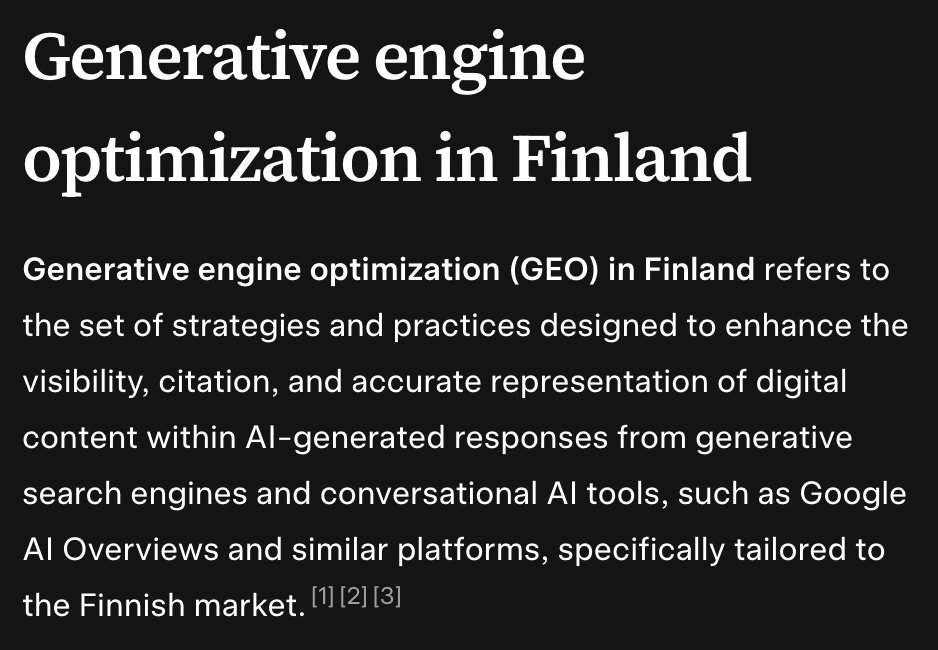
The entire article is essentially just rewritten slop from Wikipedia’s article on “generative engine optimization”, with “in Finland” or a variant at the end of every sentence.
And that’s the note I’ll end on. The internet is a weird place and it’s getting weirder every day.
Breaking Update, 2/26/26
That was fast. A day after I published this, the article “answer engine optimization” has been redirected into “generative engine optimization.” Looks like I’m going to have to write more about this one.
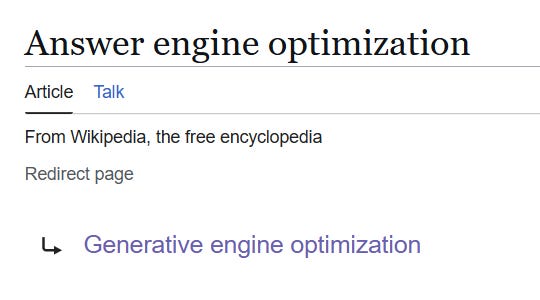
Big stuff! Let’s see if it sticks.
I suspect that you could produce a very long list of "Wikipedia articles about the same thing from different viewpoints" if you went looking for them. The often-siloed nature of academia provides plenty of fertiliser of them.